
Automated Storage and Retrieval Systems (AS/RS): A Comprehensive Overview
AS/RS systems, detailed in numerous PDF resources, utilize computer-controlled machines for automated storage and retrieval, enhancing warehouse and factory efficiency.
Automated Storage and Retrieval Systems (AS/RS) represent a significant advancement in logistics and warehouse management, as extensively documented in available PDF literature. These systems fundamentally shift operations from labor-intensive manual processes to computer-controlled automation. Core to their function is the ability to automatically place and retrieve loads from defined storage locations.

Numerous research papers, often available as PDF downloads, highlight the transition from traditional forklift-based systems to the speed and safety offered by AS/RS. They are employed across diverse sectors, including manufacturing and distribution centers, optimizing space utilization and minimizing human error. The increasing adoption reflects a demand for greater efficiency and accuracy in modern supply chains, a trend thoroughly explored in recent PDF analyses.
Historical Development of AS/RS
The evolution of Automated Storage and Retrieval Systems (AS/RS), detailed in historical PDF reports, began with early automated warehousing concepts in the 1950s. Initial systems were large, expensive, and primarily utilized by large corporations. Subsequent decades saw advancements in computer technology and control systems, driving down costs and increasing functionality, as evidenced by numerous PDF case studies.
The shift from human-operated forklifts to automated solutions, a key theme in available PDF research, accelerated in the late 20th and early 21st centuries. Recent PDF publications demonstrate a focus on wireless communication integration and sophisticated control policies, like dwell-point control, further refining AS/RS capabilities and broadening their applicability across industries.
Basic Components of an AS/RS
PDF documentation consistently highlights core AS/RS components. These include the Storage and Retrieval Machines (SRMs), often stacker cranes, responsible for automated movement of goods. Conveyor systems transport loads to and from the SRMs and other areas. Crucially, a sophisticated Control System and Software manages all operations, optimizing efficiency and accuracy, as detailed in various PDF analyses.
Further PDF resources emphasize the importance of racking systems for storage, input/output stations for loading and unloading, and associated safety features. The integration of these components, as illustrated in system design PDFs, creates a seamless automated flow, minimizing human intervention and maximizing throughput.
Storage and Retrieval Machines (Stacker Cranes)
PDF reports consistently identify Stacker Cranes as central to AS/RS functionality. These machines, detailed in system design PDFs, automate the vertical movement of goods within the racking structure. They operate on rails, navigating aisles to precisely locate and retrieve stored items. PDF analyses showcase varying crane designs, including single-mast and double-mast configurations, tailored to specific storage needs.
Furthermore, PDF documentation emphasizes the importance of crane control systems, ensuring accurate positioning and safe operation. Modern cranes often incorporate advanced features like load balancing and collision avoidance, as described in recent PDF publications, enhancing overall system reliability and efficiency.
Conveyor Systems
PDF documentation frequently highlights Conveyor Systems as integral components within AS/RS implementations. These systems, detailed in various PDF reports, facilitate the seamless transport of materials between storage locations, input/output stations, and manufacturing processes. PDF analyses showcase diverse conveyor types, including belt, roller, and powered conveyors, selected based on load characteristics and throughput requirements.
Moreover, PDF resources emphasize the role of conveyor control systems in optimizing material flow and minimizing bottlenecks. Integration with the AS/RS control software, as described in recent PDF publications, ensures synchronized operation and efficient order fulfillment. These systems are crucial for maximizing the benefits of automated storage.
Control Systems and Software
PDF documents consistently emphasize that Control Systems and Software are the brains of any AS/RS. These systems, detailed in numerous PDF analyses, manage all aspects of operation, from storage and retrieval to inventory tracking and order fulfillment. PDF reports showcase sophisticated algorithms for optimizing throughput and minimizing travel times.
Furthermore, PDF resources highlight the importance of seamless integration with Warehouse Management Systems (WMS) and Enterprise Resource Planning (ERP) systems. Modern AS/RS software, as described in recent PDF publications, often incorporates advanced features like real-time monitoring and predictive maintenance, enhancing overall system reliability;

Types of AS/RS
PDF documentation reveals a diverse range of AS/RS types, each suited for specific applications. Unit-Load AS/RS, frequently detailed in PDF guides, handle large pallet-sized loads, ideal for high-volume distribution centers. Conversely, Mini-Load AS/RS, as illustrated in various PDF case studies, manage smaller items and cases, common in e-commerce fulfillment.

PDF reports also cover Vertical Lift Modules (VLMs) and Horizontal Carousel Systems, offering dense storage within a smaller footprint. The selection, as outlined in PDF design guides, depends on factors like throughput requirements, space constraints, and the nature of the stored goods.
Unit-Load AS/RS
PDF resources consistently describe Unit-Load AS/RS as systems designed for handling large, palletized loads – often entire unit loads of goods. These systems, detailed in numerous PDF case studies, are prevalent in large distribution centers and warehouses requiring high throughput. PDF documentation highlights their reliance on stacker cranes for automated storage and retrieval.
PDF design guides emphasize that Unit-Load AS/RS maximizes storage density by utilizing the full vertical height of a warehouse. They are frequently presented in PDF format alongside simulations demonstrating their efficiency in managing substantial inventory volumes, reducing labor costs, and improving order fulfillment speed.
Mini-Load AS/RS
PDF analyses reveal that Mini-Load AS/RS systems are engineered for smaller items – cases, totes, or individual units – contrasting with unit-load systems. Numerous PDF reports detail their application in environments needing high-speed picking and sorting, like e-commerce fulfillment centers. PDF schematics often illustrate their compact design and use of smaller stacker cranes.
PDF implementation guides emphasize that Mini-Load AS/RS excels at handling a diverse range of SKUs. PDF case studies demonstrate their effectiveness in automating order consolidation and reducing picking errors. These systems, frequently documented in PDF format, offer a flexible and scalable solution for businesses with complex inventory profiles.
Vertical Lift Modules (VLMs)
PDF documentation highlights Vertical Lift Modules (VLMs) as a type of high-density storage system, differing from traditional AS/RS configurations. PDF diagrams showcase their enclosed design, utilizing an automated extractor to deliver goods to an operator. Several PDF reports emphasize VLMs’ space-saving capabilities, making them ideal for facilities with limited floor space.
PDF guides detail how VLMs improve ergonomics by bringing the product to the picker, reducing bending and walking. PDF analyses demonstrate increased picking accuracy and reduced labor costs. PDF case studies illustrate successful VLM implementations across various industries, showcasing their versatility and efficiency in automated storage solutions.
Horizontal Carousel Systems
PDF resources describe Horizontal Carousel Systems as a dynamic storage solution within the broader AS/RS landscape. These systems, detailed in PDF schematics, feature rotating shelves or carriers that deliver items to a designated access point. PDF analyses emphasize their “goods-to-person” principle, minimizing worker travel time and boosting productivity.
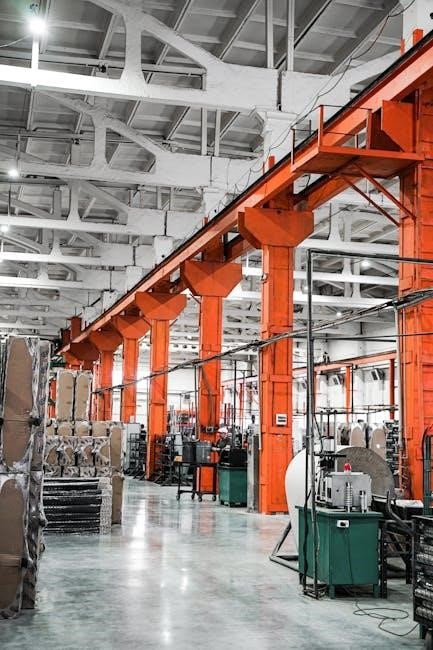
PDF guides illustrate how horizontal carousels optimize space utilization, particularly in areas with high-volume, fast-moving inventory. PDF case studies demonstrate successful implementations in distribution centers and light manufacturing. PDF reports highlight improved order accuracy and reduced labor requirements, making them a cost-effective AS/RS component.
Travel Time Models in AS/RS
PDF documents extensively cover Travel Time Models as critical for AS/RS performance evaluation. These models, detailed in academic PDFs, aim to accurately estimate the time required for stacker cranes to complete storage and retrieval cycles. A PDF review from 2014 highlights the current state-of-the-art in these estimations.
PDF research explores various factors influencing travel time, including acceleration/deceleration rates, rack layout, and control policies. PDF simulations demonstrate the impact of different modeling approaches on system throughput. Accurate travel time prediction, as outlined in PDF guides, is essential for optimizing AS/RS control strategies and maximizing efficiency.
Factors Affecting Travel Time
PDF analyses reveal several key factors impacting AS/RS travel times. Rack layout complexity, as detailed in PDF design guides, significantly influences crane movement; Acceleration and deceleration capabilities, explored in PDF performance studies, directly affect cycle times. Control policies, like dwell-point control – discussed in a 2014 PDF review – also play a crucial role.
Furthermore, PDF research indicates that load weight and dimensions, as well as the number of simultaneous requests, contribute to travel time variations. The integration of wireless communication, highlighted in a 2025 PDF, can potentially reduce delays. Optimizing these factors, as shown in PDF simulations, is vital for efficient AS/RS operation.
Optimization of Travel Time
PDF documents emphasize optimizing AS/RS travel time through strategic control policies. A 2014 PDF review details dwell-point and zone control methods for minimizing crane idle time. Simulation techniques, described in PDF design guides, allow for testing and refinement of these strategies before implementation.
Furthermore, PDF research suggests optimizing rack layouts to reduce travel distances. Implementing fast and reliable wireless communication, as explored in a 2025 PDF, can minimize delays. Advanced algorithms, detailed in various PDF studies, dynamically assign tasks to reduce congestion. Efficient AS/RS operation relies on continuous monitoring and adjustment, as highlighted in available PDF resources.
Control Policies for AS/RS
PDF literature extensively covers AS/RS control policies, crucial for efficient operation; A key strategy, detailed in a 2014 PDF review, is dwell-point control, where the stacker crane waits at specific points to minimize travel. Zone control, also discussed in PDF resources, divides the warehouse into sections, assigning cranes to specific zones.
Further PDF research explores more complex policies, utilizing algorithms to dynamically assign tasks. These policies aim to reduce congestion and optimize throughput. The integration of wireless communication, as outlined in a 2025 PDF, enables real-time adjustments to control policies. Effective control is vital, as highlighted in numerous PDF guides, for maximizing AS/RS performance.
Dwell-Point Control
Dwell-point control, extensively analyzed in AS/RS PDF documentation, is a fundamental control policy. A 2014 PDF review details how this method involves the stacker crane pausing at predetermined locations – dwell points – within the storage system. This minimizes overall travel time by anticipating future retrieval requests and positioning the crane strategically;
PDF resources emphasize that effective dwell-point placement requires careful analysis of storage and retrieval patterns. The goal, as described in various PDF guides, is to reduce the distance traveled for subsequent operations. While simple to implement, PDF studies show dwell-point control’s efficiency depends heavily on accurate demand forecasting.
Zone Control

Zone control, frequently discussed in AS/RS PDF literature, divides the storage system into distinct zones, each managed by a dedicated stacker crane or set of cranes. PDF analyses highlight that this approach enhances throughput by minimizing crane interference and contention for access to storage locations.

Several PDF resources detail how zone control is particularly effective in high-throughput applications. It reduces travel distances within each zone, improving efficiency. However, PDF studies also note that coordinating multiple cranes and managing the transfer of loads between zones presents a significant control challenge. Optimal zone configuration, as outlined in PDF guides, requires careful consideration of storage and retrieval patterns.
Applications of AS/RS

AS/RS PDF documentation extensively covers diverse applications, prominently featuring manufacturing systems and warehouse/distribution centers. PDF reports demonstrate their use in automatically managing work-in-progress inventory, streamlining production flow, and reducing material handling costs within factories.
Furthermore, PDF analyses reveal widespread adoption in logistics, where AS/RS optimizes storage density, accelerates order fulfillment, and minimizes labor requirements. Specific PDF case studies illustrate successful implementations across industries like automotive, pharmaceuticals, and food & beverage. Even specialized applications, like the NASA ASRS detailed in a PDF report, showcase confidential incident reporting system benefits.
Manufacturing Systems
AS/RS PDF resources highlight significant integration within manufacturing, automating the flow of materials and work-in-progress. These systems, as detailed in various PDF articles, manage inventory between production stages, reducing bottlenecks and improving throughput. PDF analyses demonstrate how AS/RS minimizes manual handling, enhancing safety and accuracy.
PDF case studies showcase AS/RS applications in automated production lines, enabling just-in-time delivery of components. The PDF documentation emphasizes the role of AS/RS in supporting flexible manufacturing systems, adapting to changing product mixes. Designs for manufacturing systems, outlined in a PDF, optimize space and efficiency.
Warehouse and Distribution Centers
AS/RS PDF documentation extensively covers their deployment in warehouses and distribution centers, revolutionizing order fulfillment processes. These PDF resources detail how AS/RS maximizes storage density, crucial for facilities with limited space, as noted in overview PDFs. PDF analyses demonstrate significant reductions in labor costs and improved order accuracy.
PDF case studies illustrate AS/RS enabling faster order cycle times and increased shipping capacity. The PDF literature emphasizes the system’s ability to handle high volumes and diverse product types. PDF guides showcase how AS/RS integrates with warehouse management systems (WMS) for seamless operation and real-time inventory control.
Benefits of Implementing AS/RS
AS/RS PDF reports consistently highlight increased storage density as a primary benefit, optimizing warehouse space utilization. Numerous PDF analyses demonstrate improved accuracy, minimizing errors and reducing costly mis-shipments. PDF documentation details substantial labor cost reductions through automation, freeing personnel for value-added tasks.
PDF case studies showcase faster order fulfillment cycles, enhancing customer satisfaction. The PDF literature emphasizes improved inventory control and reduced inventory levels. PDF guides illustrate enhanced workplace safety by minimizing manual handling. PDF resources confirm increased throughput and overall operational efficiency when implementing AS/RS.
Increased Storage Density
AS/RS PDF documentation consistently emphasizes a significant increase in storage density as a core advantage. Traditional storage methods often leave substantial wasted vertical space; PDF analyses show AS/RS maximizes cube utilization. PDF reports detail how high-bay racking, coupled with automated retrieval, dramatically increases storage capacity within the same footprint;

PDF case studies illustrate that AS/RS can double or even triple storage density compared to conventional warehousing. PDF guides explain how minimizing aisle widths further contributes to space savings. PDF resources confirm that optimized storage density translates directly into reduced real estate costs and improved operational efficiency.
Improved Accuracy and Reduced Labor Costs
AS/RS PDF reports consistently highlight improved order accuracy and substantial labor cost reductions. Automated systems minimize human error inherent in manual picking and put-away processes, as detailed in various PDF analyses. PDF documentation showcases how AS/RS reduces reliance on forklift operators and warehouse personnel for routine tasks.
PDF case studies demonstrate significant decreases in picking errors and inventory discrepancies. PDF guides explain how automation frees up labor for value-added activities. PDF resources confirm that reduced labor requirements translate into lower operational expenses and increased overall profitability for businesses implementing AS/RS.
Future Trends in AS/RS
AS/RS PDF analyses point towards increasing integration of wireless communication technologies, as evidenced by recent PDF studies on new AS/RS applications. These PDF reports detail a shift towards more flexible and adaptable systems. The “Document as Code” approach, discussed in PDF documentation, is gaining traction for managing AS/RS documentation efficiently.
PDF research indicates a growing focus on real-time data analytics and predictive maintenance within AS/RS. PDF guides suggest advancements in robotics and artificial intelligence will further optimize system performance. PDF resources highlight the potential of cloud-based AS/RS control systems for enhanced scalability and accessibility.
Wireless Communication Integration
PDF documents reveal a significant transition within warehouse systems, moving away from traditional forklift operations towards faster, safer AS/RS applications. These PDF analyses emphasize the crucial role of wireless communication in enabling this shift. PDF studies detail how wireless technologies facilitate real-time data exchange between AS/RS components, improving responsiveness and efficiency.
PDF reports showcase the benefits of wireless integration, including reduced cabling costs and increased system flexibility. PDF guides highlight the use of wireless networks for remote monitoring and control of AS/RS. Further PDF research suggests advancements in wireless security protocols are vital for protecting sensitive data within these systems.
Document as Code Approach to AS/RS Documentation

Applying software development principles to AS/RS documentation, as detailed in various PDF resources, improves quality and efficiency. This “Document as Code” (doc-as-code) approach, explored in PDF guides, treats documentation like source code – version controlled, collaboratively edited, and automated. PDF analyses suggest this method streamlines updates and ensures accuracy.
PDF reports highlight benefits like easier maintenance and improved consistency across AS/RS system documentation. Utilizing tools and workflows familiar to developers, as described in PDF studies, reduces the barrier to contribution. PDF examples demonstrate how doc-as-code facilitates automated generation of AS/RS manuals and training materials.
Leave a Reply
You must be logged in to post a comment.