Frog Dissection Worksheet Answer Key PDF: A Comprehensive Plan
Comprehensive PDF resources detail frog anatomy, aiding educators and students with dissection worksheets and answer keys. Digital dissection simulators enhance learning!
Frog dissection, a cornerstone of biology education, utilizes worksheets to guide students through anatomical exploration. These worksheets, often available as PDF documents, provide labeled diagrams and questions assessing understanding of frog morphology. Accessing a reliable answer key is crucial for effective learning and self-assessment. Digital resources, like the “Dissection Simulator: Frog Edition,” complement traditional methods, offering interactive experiences.
The availability of PDF answer keys streamlines the grading process for educators and allows students to verify their comprehension independently. Resources such as Apple Frog Visual Dissection Guides further enhance the learning experience, providing detailed illustrations and orientation assistance. These tools collectively aim to foster a deeper understanding of biological structures and functions.
II. Importance of Frog Dissection in Biology Education
Frog dissection remains vital in biology, offering hands-on experience unattainable through textbooks alone. Utilizing accompanying worksheets – frequently in PDF format – reinforces learning and provides structured exploration of anatomy. A corresponding answer key ensures accurate self-assessment and facilitates effective teaching. These resources bridge theoretical knowledge with practical application, solidifying understanding of organ systems.
Furthermore, dissection fosters critical thinking, observational skills, and anatomical spatial reasoning. Digital alternatives, while valuable, often cannot replicate the tactile learning of physical dissection. Access to clear PDF worksheets and reliable answer keys is paramount for maximizing the educational benefits of this time-honored practice, preparing students for advanced biological studies.
III. Understanding Frog Anatomy: External Features
Initial exploration focuses on external features, crucial for understanding frog morphology. Worksheets, often available as PDF downloads, guide students in identifying key structures like the tympanic membrane, nictitating membrane, and webbed feet. A detailed answer key is essential for verifying correct labeling and comprehension. These exercises build a foundational understanding before internal dissection.
Students learn to differentiate between dorsal and ventral surfaces, observe skin texture, and note limb proportions. Properly designed PDF worksheets incorporate diagrams for labeling and comparative analysis. The answer key should clearly illustrate correct anatomical positioning. Mastering external anatomy provides context for understanding the internal organ systems and their functions, enhancing the overall dissection experience.
III.A. Identifying Key External Structures
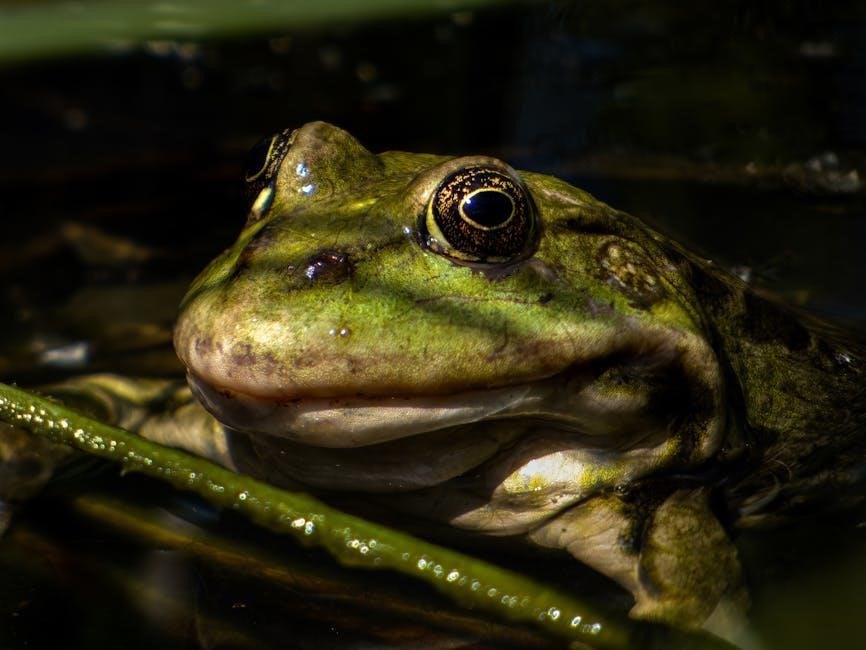
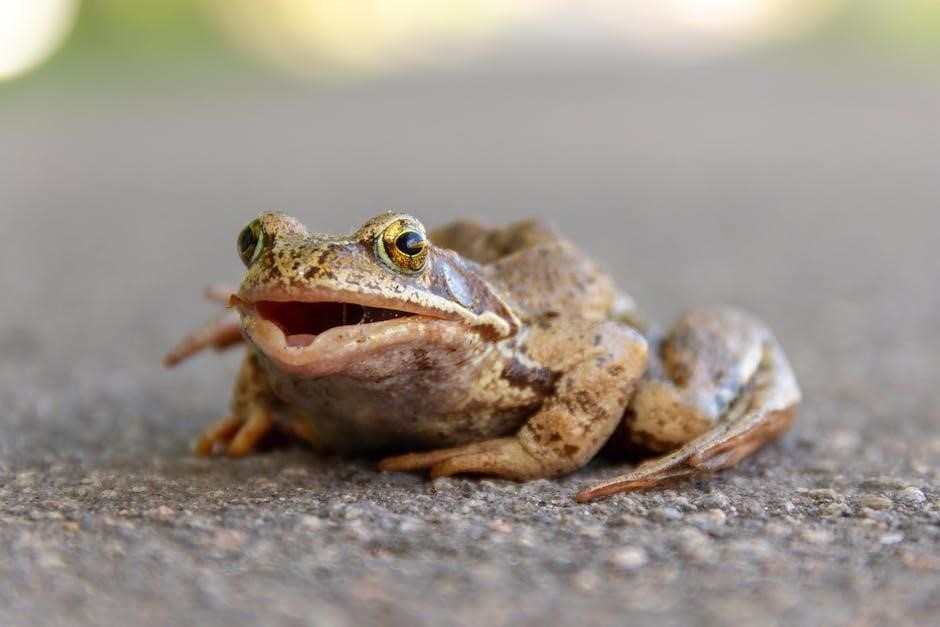
PDF worksheets for external frog anatomy emphasize identifying structures like the eyes (with nictitating membrane), tympanic membranes (eardrums), external nares (nostrils), and the mouth. Students also label the forelimbs, hind limbs, and webbed feet. A comprehensive answer key is vital, showcasing accurate placement and descriptions of each feature.
Detailed diagrams within the worksheets should clearly illustrate these structures. Students learn to distinguish between the dorsal and ventral sides, noting the skin’s texture and coloration. The answer key should include notes on the function of each external part. Accurate identification forms the basis for understanding internal organ relationships and overall frog physiology, preparing students for dissection.
III.B. Using Worksheets for External Anatomy Labeling
Frog dissection worksheets featuring unlabeled diagrams are crucial for reinforcing external anatomy knowledge. Students actively learn by labeling structures like the head, trunk, limbs, and cloaca. A corresponding answer key, available in PDF format, provides immediate feedback and corrects misconceptions.
Effective worksheets incorporate varying difficulty levels, starting with basic labeling and progressing to identifying specific features (e.g., digits, webbing). The answer key should not only show correct labels but also briefly explain each structure’s function. This promotes deeper understanding. Utilizing these PDF resources enhances student engagement and prepares them for the internal dissection process.

IV. Internal Anatomy: The Dissection Process
Successfully navigating internal frog anatomy requires a systematic approach, often guided by detailed worksheets. These PDF resources outline step-by-step dissection procedures, ensuring students correctly identify organs like the heart, lungs, liver, and intestines. An accompanying answer key is vital for verifying accurate identification and understanding spatial relationships.
Worksheets should emphasize proper tool usage and safety protocols. The answer key can include diagrams highlighting key structures and potential dissection challenges. Digital dissection simulators, complementing the PDF worksheets, offer a risk-free environment for practice before the actual lab, improving confidence and skill.
IV.A. Step-by-Step Dissection Guide Overview
A robust frog dissection guide, often available as a PDF, begins with external examination before proceeding to internal structures. Worksheets accompanying the guide should detail each step – skinning, muscle layer exposure, and organ identification. The answer key provides visual confirmation of correct incisions and anatomical landmarks.
Guides typically start with a midline incision, followed by lateral cuts to expose the abdominal cavity. Careful attention to detail, as highlighted in the PDF and reinforced by the worksheet, is crucial. The answer key should illustrate proper technique, minimizing damage to delicate organs and ensuring accurate observation.
IV.B. Common Dissection Tools and Their Uses
Essential tools for frog dissection, detailed in accompanying PDF guides and worksheets, include dissecting scissors, forceps, probes, and pins. Scissors facilitate precise incisions, while forceps aid in lifting and separating tissues. Probes help identify structures, and pins secure the frog during the process. The answer key often references proper tool usage.
Scalpels, though sometimes used, require greater caution. PDF resources emphasize safety protocols for each tool. Worksheet exercises may ask students to identify the appropriate tool for specific tasks. A complete answer key should demonstrate correct tool selection and application for optimal dissection and anatomical understanding.
V. The Digestive System of the Frog
The frog’s digestive system, thoroughly covered in dissection worksheets and their answer keys, comprises the esophagus, stomach, small and large intestines, liver, and pancreas. PDF guides illustrate the pathway of food, from ingestion to waste elimination. Students identify these organs during dissection, labeling them accurately on worksheets.
Answer keys detail the function of each component – the stomach’s role in chemical breakdown, the intestines’ absorption of nutrients, and the liver’s detoxification processes. Worksheet questions assess understanding of digestive function. Comprehensive PDF resources provide detailed diagrams and explanations, ensuring accurate anatomical identification and functional comprehension.
V.A. Identifying the Esophagus, Stomach, and Intestines
Frog dissection worksheets, accompanied by detailed answer keys in PDF format, guide students in identifying the esophagus – a muscular tube connecting the mouth to the stomach. The stomach, a J-shaped organ, is easily located, and the intestines, comprising the small and large varieties, are distinguished by diameter and coiled structure.
PDF guides provide clear illustrations, aiding accurate identification. Worksheet exercises require students to label these organs on diagrams. Answer keys confirm correct placement and highlight key features. Successful identification is crucial for understanding digestive processes, as detailed in accompanying dissection materials.
V.B. Worksheet Questions on Digestive Function
Frog dissection worksheet answer keys in PDF format include questions assessing understanding of digestive function. These questions probe knowledge of enzyme roles within the stomach and intestines, nutrient absorption processes, and the pathway of food through the digestive tract. Students analyze how each organ contributes to breaking down food.
Worksheets often present scenarios requiring application of learned concepts. Answer keys provide detailed explanations, clarifying correct responses and addressing common misconceptions. These resources reinforce the link between anatomical structure and physiological function, solidifying comprehension of the frog’s digestive system.
VI. The Respiratory and Circulatory Systems
Frog dissection worksheet answer key PDFs thoroughly cover respiratory and circulatory anatomy. Students identify lungs, heart chambers, and major blood vessels. Questions assess understanding of pulmonary and systemic circulation, detailing oxygenated versus deoxygenated blood flow. Worksheets often include diagrams for labeling and tracing blood pathways.
Answer keys explain the frog’s unique three-chambered heart and its implications for oxygen delivery. They clarify how cutaneous respiration supplements lung function. These resources emphasize the interconnectedness of these systems, reinforcing comprehension of gas exchange and circulatory efficiency within the amphibian body.
VI.A; Locating the Lungs and Heart
Frog dissection worksheet answer key PDFs guide students to precisely locate the lungs and heart within the thoracic cavity. Diagrams highlight the thin, sac-like lungs positioned ventrally to the heart. The heart, identifiable by its conical shape, is centrally located. Worksheets prompt students to differentiate between the atria and ventricle.
Answer keys confirm correct identification, noting the heart’s position nestled amongst the liver and other organs. They emphasize observing the conus arteriosus and sinus venosus. Detailed illustrations aid in visualizing these structures, ensuring accurate anatomical placement during the dissection process.
VI.B. Understanding Blood Flow in Frogs (Worksheet Focus)
Frog dissection worksheet answer key PDFs emphasize tracing blood flow – a crucial aspect of amphibian physiology. Worksheets typically ask students to diagram the circulatory pathway, starting with deoxygenated blood entering the sinus venosus. Answer keys detail the route through the right atrium, ventricle, and pulmonary artery to the lungs.
Students then map oxygenated blood’s return via the pulmonary veins to the left atrium, then ventricle, and finally, the aorta. PDF resources clarify the role of cutaneous respiration, supplementing pulmonary gas exchange. Correctly labeling these vessels, as confirmed by the answer key, demonstrates comprehension.
VII. The Urogenital System
Frog dissection worksheet answer key PDFs provide detailed diagrams of the urogenital system. Students identify kidneys, ureters, the urinary bladder, and cloaca – key components of excretion. Worksheets also focus on reproductive organs, differentiating between male (testes, ductus deferens) and female (ovaries, oviducts) anatomy.
Answer keys clarify the connection between these structures and their functions in waste removal and reproduction. Understanding how urine is formed and expelled, and how gametes are produced and released, is assessed. PDF resources often include questions about the cloaca’s role as a common exit point.
VII.A. Identifying Kidneys, Bladder, and Reproductive Organs
Frog dissection worksheet answer key PDFs guide students in locating the dark-colored kidneys positioned dorsally in the abdominal cavity. They illustrate identifying the ureters connecting kidneys to the urinary bladder, and the bladder itself, responsible for urine storage. Worksheets emphasize distinguishing male testes (small, oval) from female ovaries (larger, often lobed).

Answer keys confirm correct identification of the ductus deferens in males and oviducts in females, tracing their path towards the cloaca. Detailed diagrams aid in recognizing these structures, crucial for understanding amphibian excretion and reproduction. PDF resources often include labeling exercises.
VII.B. Worksheet Questions on Excretion and Reproduction
Frog dissection worksheet answer key PDFs typically include questions assessing understanding of kidney function – filtering waste from blood to form urine. Students analyze how the bladder stores urine before expulsion through the cloaca. Reproductive system questions focus on gamete production: sperm in testes, eggs in ovaries.
Worksheets probe knowledge of fertilization (external in frogs) and the roles of oviducts/ductus deferens. Answer keys clarify how the urogenital system contributes to both waste removal and propagation of the species. Comparative anatomy questions may link frog systems to those of other vertebrates.
VIII. The Nervous System
Frog dissection worksheet answer key PDFs dedicate sections to the central nervous system – brain and spinal cord. Students identify brain regions (cerebrum, cerebellum, optic lobes) and trace the spinal cord’s path. Questions assess understanding of nerve function and reflex arcs. Advanced worksheets explore neurotransmitters like acetylcholine at the muscle end-plate, detailing synaptic transmission.
Answer keys explain how the nervous system coordinates frog behavior and responses to stimuli. Diagrams illustrate neural pathways. Some PDFs connect frog neuroanatomy to human systems, fostering comparative understanding. Expect questions on sensory perception and motor control.
VIII.A. Brain and Spinal Cord Identification
Frog dissection worksheet answer key PDFs prominently feature diagrams for identifying brain structures: cerebrum, cerebellum, optic lobes, and medulla oblongata. Students label these regions, demonstrating anatomical knowledge. Answer keys provide precise locations and functions. The spinal cord’s dorsal and ventral aspects are also key identification points.
Worksheets often include questions about the relative sizes of brain regions in frogs versus mammals, prompting comparative analysis. PDFs may ask students to trace the path of nerves emanating from the brain and spinal cord. Accurate labeling is crucial for assessment, with answer keys serving as a guide.
VIII.B. Role of Acetylcholine at the Frog Muscle End-Plate (Advanced)
Advanced frog dissection worksheet answer key PDFs delve into neuromuscular function, specifically acetylcholine’s (ACh) role. These worksheets explore how ACh transmission at the muscle end-plate initiates muscle contraction. Answer keys detail the synaptic cleft, motor neuron, and muscle fiber interaction.
Questions often address ACh analogues like tropisetron and their impact on nicotinic receptors. PDFs may present scenarios involving ACh inhibitors or enhancers, requiring students to predict physiological outcomes. Understanding this process demonstrates a sophisticated grasp of neurophysiology. Keys clarify complex mechanisms, aiding comprehension.
IX. Utilizing Dissection Simulators (Digital Resources)
Frog dissection worksheet answer key PDFs are increasingly complemented by digital resources, notably dissection simulators. These programs, like “Dissection Simulator: Frog Edition,” offer interactive anatomical exploration. Worksheets can be designed to align with simulator activities, reinforcing learning through virtual practice.
Answer keys for simulator-based assignments assess students’ ability to identify structures and understand their functions within the digital environment. Such resources provide an accessible alternative or supplement to traditional dissection, enhancing comprehension and reducing reliance on physical specimens; They are invaluable for remote learning and accessibility.
X. Frog Life Cycle and BioMio Visualization
Understanding the frog life cycle – from egg to tadpole to adult – provides crucial context for dissection studies. Worksheet answer key PDFs can incorporate questions about developmental stages, linking anatomy to physiology. BioMio offers interactive models visualizing biomolecules, including those vital to frog development and function;
These visualizations aid comprehension of complex biological processes; Integrating BioMio’s models with dissection worksheets and answer keys fosters a holistic understanding. Students can correlate anatomical structures observed during dissection with the molecular mechanisms driving their development and operation, enriching the learning experience.
XI. Symmetry in Frog Morphology (Radiolaria & Hydroids Connection)
Exploring symmetry in frog morphology – particularly radial and bilateral symmetry – offers a broader evolutionary perspective. Worksheet answer key PDFs can include comparative anatomy questions, challenging students to identify symmetrical features. Interestingly, connections exist with Radiolaria and hydroids, showcasing diverse symmetry types in the biological world.
Analyzing these connections deepens understanding of body plan evolution. Dissection worksheets can prompt students to consider how symmetry relates to frog locomotion, sensory perception, and internal organ arrangement. Linking frog anatomy to these seemingly disparate organisms broadens biological insight, enriching the answer key’s educational value.
XII. PCOS and Frog Dissection Model Relevance (Pathological Processes)
Surprisingly, research suggests links between frog models and pathological processes like Polycystic Ovary Syndrome (PCOS). While seemingly distant, studying hormonal influences on frog reproductive systems – detailed in dissection worksheet answer key PDFs – can offer insights into similar endocrine disruptions in humans. This connection highlights the broader utility of comparative anatomy.
Worksheets focusing on the frog urogenital system can be adapted to discuss hormonal regulation and its impact on organ function. The answer key could include questions prompting students to consider how disruptions in hormonal balance might manifest pathologically, fostering a deeper understanding of disease mechanisms.
XIII. Apple Frog Visual Dissection Guide & Orientation
The “Apple Frog Visual Dissection Guide,” illustrated by Leah Hofgesang, provides a valuable companion to traditional frog dissection and associated worksheets. This guide, alongside a detailed answer key PDF, offers clear visual orientation for students navigating the complexities of frog anatomy. It complements learning by presenting structures in an accessible format.
Utilizing this visual aid alongside standard dissection worksheets enhances comprehension. The answer key can be cross-referenced with the guide’s illustrations, ensuring accurate identification of structures. This resource streamlines the learning process, making frog dissection more effective and less daunting for students.
XIV. Student Lab Worksheet Answer Key: Comparative Anatomy
A crucial component of successful frog dissection is a detailed “Student Lab Worksheet Answer Key,” particularly when focusing on comparative anatomy. These keys, often available as a PDF, provide correct identifications of frog structures, enabling students to self-assess and reinforce learning. They are essential for understanding anatomical relationships.
The answer key facilitates a deeper understanding of how frog anatomy compares to other species. Utilizing a PDF format ensures easy access and distribution. Correctly completed worksheets, guided by the answer key, build a strong foundation for further biological studies and dissection skills.
XV. Quiz Answer Key & Assessment Strategies
Effective frog dissection learning requires robust assessment. A detailed “Quiz Answer Key,” often distributed as a PDF alongside worksheets, is paramount. These keys evaluate student comprehension of anatomical structures and dissection procedures. Assessment strategies should move beyond simple recall, testing analytical skills.
Consider incorporating practical exams where students identify structures on a preserved frog. Utilizing a PDF answer key streamlines grading and provides clear feedback. Combining quizzes, practical assessments, and completed worksheets offers a comprehensive evaluation of student mastery of frog anatomy.
XVI. Green Frog Plugin for Zotero (Impact Factor Display)
While seemingly unrelated to frog dissection, the “Green Frog” Zotero plugin highlights the digital tools supporting biological research. Researchers utilizing studies on frog anatomy – and creating associated worksheets or answer keys – benefit from efficient citation management. This plugin displays journal impact factors directly within Zotero.
Accessing relevant PDF resources, like published frog dissection guides, is simplified with Zotero. The plugin ensures accurate referencing when compiling educational materials. Though not directly a dissection tool, it aids in building a solid foundation of scientific literature for educators and students alike.
XVII. Frog Call Characteristics & Physiological Zoology
The study of frog calls, a branch of physiological zoology, demonstrates the interconnectedness of anatomy and function – principles reinforced through dissection. Understanding vocalization relies on knowledge of the frog’s respiratory and muscular systems, areas directly explored in dissection worksheets.
Research into call characteristics (Pseudacris) informs broader biological understanding. While not directly related to creating answer keys for frog dissection, it exemplifies the depth of study possible. Accessing research PDFs detailing these studies aids educators in providing context for anatomical learning, enriching the dissection experience.
XVIII. Frog Dissection: A Novel Modified Mouse Sepsis Model
Interestingly, frog dissection techniques are being adapted for advanced research, serving as a model for modified mouse sepsis studies. This highlights the enduring relevance of frog anatomy in biomedical research, though it doesn’t directly impact frog dissection worksheet answer keys.
While seemingly distant from basic educational PDF resources, this application underscores the foundational knowledge gained through dissection. Understanding frog physiology provides a comparative basis for studying mammalian responses to sepsis. Educators can mention this advanced application to demonstrate the broader scientific context of dissection and worksheet exercises.
XIX. Frog Design (1969) & Early Works (Apple Collaboration)
The history of “Frog Design,” established in 1969, and its early collaboration with Apple, designing the “Snow White” aesthetic in 1982, is a fascinating historical note. However, this design firm’s legacy has no direct bearing on the content or creation of frog dissection worksheet answer keys or related PDF materials.
While a compelling story about industrial design, it remains separate from the biological sciences curriculum. Students utilizing dissection worksheets won’t encounter this information; the focus remains firmly on anatomical structures and physiological functions. The connection is purely tangential and irrelevant to educational resources.
XX. Finding and Accessing PDF Worksheet Answer Keys Online
Locating frog dissection worksheet answer keys in PDF format requires careful searching. Numerous educational websites and teacher resource platforms offer these materials, often requiring registration or subscription access. Caution is advised; verify the accuracy of any downloaded key against a trusted source.
Beware of potentially inaccurate or incomplete answer keys circulating online. Reputable science education publishers and institutions are the most reliable providers. Always prioritize resources aligned with specific dissection lab manuals and curriculum standards. Proper verification ensures students receive correct guidance and assessment.
Leave a Reply
You must be logged in to post a comment.